Rails on AWS
Your comprehensive guide to deploying and scaling Ruby on Rails applications on Amazon Web Services
About the Book
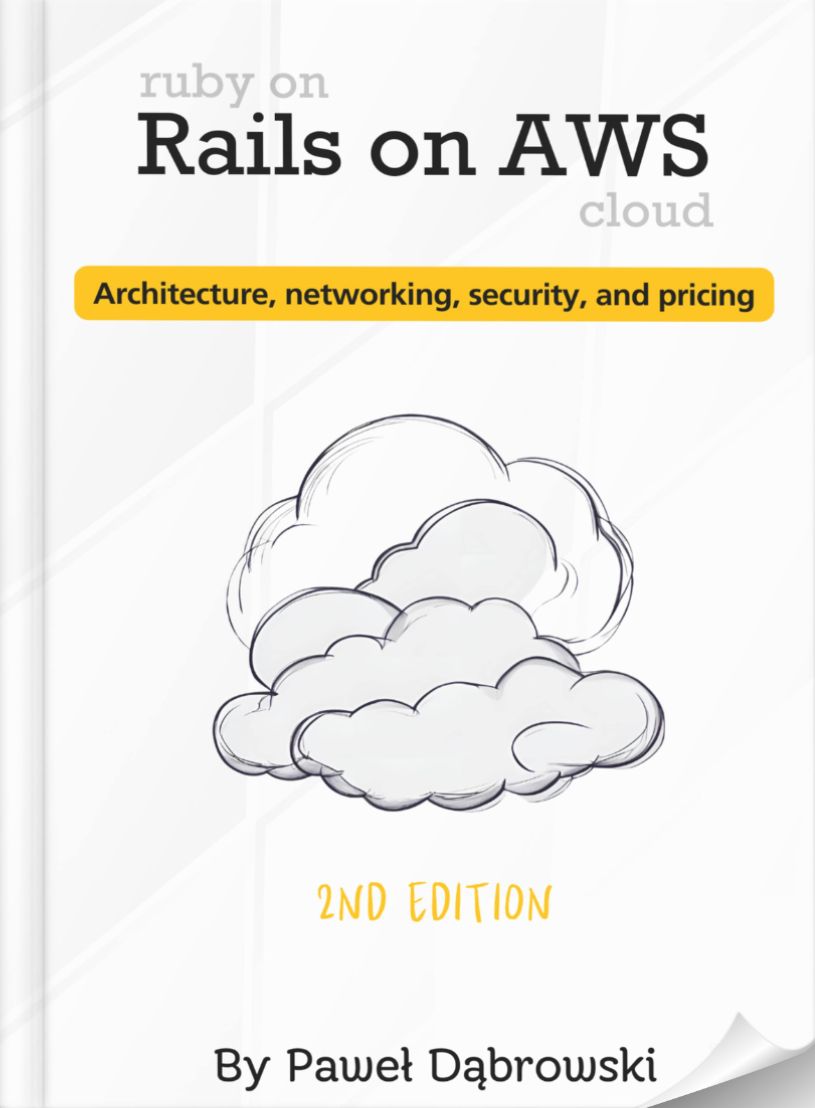
Rails on AWS is a comprehensive guide that takes you through the entire journey of deploying and scaling Ruby on Rails applications on Amazon Web Services. Whether you're a seasoned Rails developer looking to move to the cloud or a DevOps engineer working with Rails applications, this book provides practical, real-world solutions.
Learn how to architect scalable applications, configure networking and security, optimize costs, and implement best practices for running Rails applications in production on AWS. This second edition includes updated content covering the latest AWS services and Rails best practices.
Covering architecture, networking, security, and pricing, this book gives you everything you need to successfully deploy and maintain Rails applications on AWS.
Table of Contents
Introduction
Get started with AWS fundamentals and understand how Rails applications can leverage cloud infrastructure. Learn how to create an AWS account, set up users, create a test Rails application, and prepare for your cloud journey with a summary of next steps.
Simple Storage Service (S3)
Learn about Amazon S3 including service explanation, use cases for Rails applications, configuration setup, pricing models, permissions management, and development integration with Active Storage.
CloudFront
Explore Amazon CloudFront CDN with service explanation, pricing models, configuration and development setup, accessing private S3 bucket files, and customizing cache expiration times for optimal performance.
AWS Transfer Family
Master AWS Transfer Family with service explanation, pricing models, configuration setup, permissions management, adding the first user and uploading files, and development integration for secure SFTP, FTPS, and FTP file transfers in Rails applications.
Lambda
Discover AWS Lambda including service explanation, use cases for Rails applications, pricing models, and configuration and development setup for serverless computing, background jobs, webhooks, and event-driven architectures.
EC2
Guide to Amazon EC2 covering pricing models and configuration for deploying and managing Rails applications on virtual servers, including instance selection, auto-scaling, and load balancing.
Relational Database Service (RDS)
Understand Amazon RDS with service explanation, pricing models, and configuration for setting up and managing PostgreSQL or MySQL databases, including migrations, backups, read replicas, and performance optimization for Rails applications.
DynamoDB
Learn about Amazon DynamoDB including service explanation, pricing models, configuration, development integration, and running DynamoDB locally with Docker for Rails applications.
ElastiCache
Explore Amazon ElastiCache with service explanation, pricing models, configuration, and development integration for implementing Redis and Memcached caching to improve Rails application performance.
Simple Email Service
Master Amazon SES including service explanation, pricing models, configuration and development setup, and the approval process for sending transactional and marketing emails from Rails applications.
Parameter Store
Guide to AWS Systems Manager Parameter Store covering pricing models, configuration setup, and permissions management for securely storing and managing configuration data, secrets, and environment variables in Rails applications.
Elastic Container Registry
Guide to Amazon ECR covering pricing models and configuration for storing and managing Docker container images for Rails applications, including image building, pushing, and version management.
Elastic Container Service
Discover Amazon ECS with pricing models, configuration, development setup, containers configuration, adding Sidekiq instances, management, automated deployment with CI/CD on GitHub, and accessing containers to run Rails console for containerized Rails applications.
CloudWatch
Understand Amazon CloudWatch including service explanation, pricing models, and configuration and development setup for monitoring Rails applications with metrics, logs, alarms, and dashboards.
Cognito
Learn about Amazon Cognito including service explanation, pricing models, configuration, development integration, and using Cognito without SES for implementing user authentication and authorization in Rails applications.
Route 53
Explore Amazon Route 53 with service explanation, use cases, pricing models, and configuration for DNS management and domain routing, including custom domains, health checks, and failover for Rails applications.
Open Source Search Engine
Master Amazon OpenSearch Service including service explanation, pricing models, and configuration and permissions for setting up full-text search capabilities in Rails applications.
Transcribe
Discover Amazon Transcribe with service explanation, pricing models, configuration and permissions, and development integration for converting speech to text in Rails applications.
Changelog
Documentation of changes, updates, and improvements made to this edition of the book, including new features and revised content.
About the Author

Paweł Dąbrowski
Paweł Dąbrowski is an experienced software engineer and AWS solutions architect with extensive expertise in deploying and scaling Ruby on Rails applications on cloud infrastructure. With years of hands-on experience, Paweł brings practical insights and real-world solutions to help developers successfully navigate the AWS ecosystem.
Frequently Asked Questions
While some familiarity with AWS concepts is helpful, the book is designed to be accessible to developers who are new to AWS. We start with the fundamentals and gradually build up to more advanced topics, making it suitable for both beginners and experienced developers.
The second edition covers Rails 7.x and includes best practices that are applicable to modern Rails applications. The concepts and patterns discussed are relevant regardless of your specific Rails version.
Yes! Each chapter covering an AWS service includes detailed pricing information, helping you understand the costs associated with each service.
Yes, the book covers containerization strategies with Docker and AWS ECS (Elastic Container Service).
Absolutely! The book is filled with practical code examples, configuration files, and step-by-step instructions. Each chapter includes real-world scenarios, pricing information for the services covered, and best practices that you can immediately apply to your own Rails applications.
The book covers essential AWS services including S3, CloudFront, AWS Transfer Family, Lambda, EC2, RDS, DynamoDB, ElastiCache, SES, Parameter Store, ECR, ECS, CloudWatch, Cognito, Route 53, OpenSearch, and Transcribe. Each chapter provides a detailed explanation of the service, its use cases, pricing models, configuration, and development integration. All services are explained in the context of deploying and running Rails applications, with pricing information included for each service covered.